Your car’s safety systems are only as reliable as their last calibration.
Karl Malone’s Body & Paint helps drivers restore more than just visible vehicle damage after a collision. Modern vehicles rely on Advanced Driver Assistance Systems (ADAS), including automatic emergency braking, lane departure warnings, blind-spot monitoring, and adaptive cruise control. When repairs involve components such as windshields, bumpers, suspension systems, or structural parts, these safety systems often require recalibration to function as intended.
Why Is ADAS Calibration Necessary After a Repair?
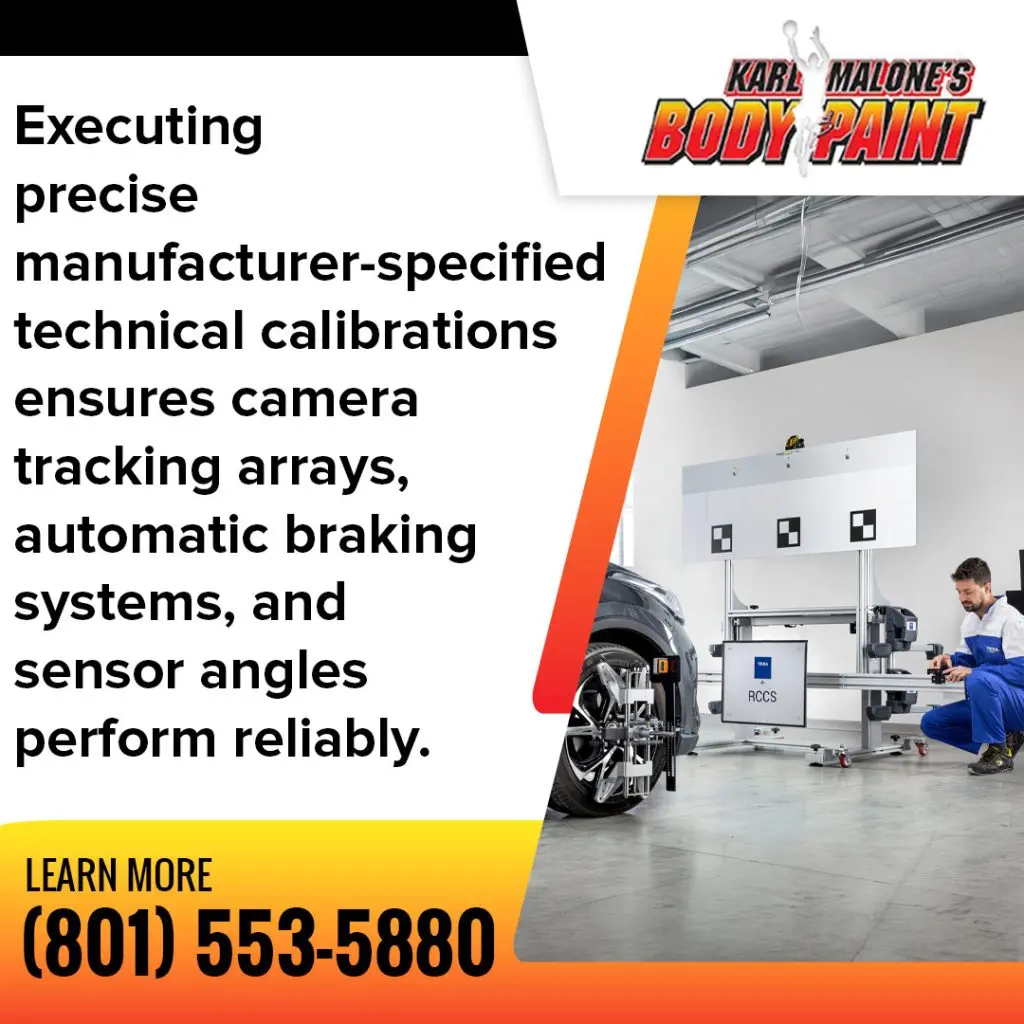
ADAS cameras and sensors are mounted at precise angles and locations throughout a vehicle. Even minor changes during a repair can affect how these systems detect road conditions, nearby vehicles, and potential hazards. Calibration restores sensors to manufacturer specifications, helping ensure that safety features perform accurately after repairs are completed.
Many drivers in Riverton, UT, and across the Salt Lake Valley do not realize that common collision-related repairs can affect sensor accuracy and may require recalibration. Choosing an auto body repair shop that follows OEM calibration procedures is an important step in helping maintain the performance of a vehicle’s built-in safety technologies.
ADAS Calibration at a Glance
| Common Repair | Potential ADAS Impact |
| Windshield Replacement | May require forward-facing camera recalibration |
| Front or Rear Bumper Repair | Can affect radar and ultrasonic sensor alignment |
| Suspension or Wheel Alignment Work | May change how road-facing sensors interpret surroundings |
| Structural or Frame Repairs | Can alter sensor reference points throughout the vehicle |
| Sensor Repositioning or Replacement | Typically requires OEM-specified calibration procedures |
Key Point: Even when vehicle damage appears minor, repairs involving sensor mounting locations can affect the accuracy of driver-assistance systems. Following OEM calibration procedures helps ensure these safety features perform as intended.
How ADAS Helps Prevent Accidents
Modern vehicles use Advanced Driver Assistance Systems (ADAS) to help drivers identify hazards and respond more quickly to changing road conditions. Features such as automatic emergency braking, lane-keep assist, adaptive cruise control, blind-spot monitoring, and rear cross-traffic alerts continuously monitor the vehicle’s surroundings using cameras, radar sensors, and other advanced technology.
According to the National Highway Traffic Safety Administration (NHTSA), these systems are designed to reduce crashes and lessen the severity of collisions by providing warnings or automatic intervention when potential dangers are detected. As ADAS technology becomes standard on more vehicles, drivers increasingly rely on these systems as an additional layer of safety during everyday travel.
To perform accurately, ADAS cameras and sensors must remain properly aligned. Even minor changes caused by a collision, windshield replacement, bumper repair, suspension work, or structural repairs can affect how these systems interpret their surroundings. That is why manufacturers often require calibration after repairs to help restore ADAS performance to factory specifications.
What Happens to Sensors During a Collision Repair?
Most vehicle owners understand that a collision can damage body panels, bumpers, and frames. Fewer realize how many of those components also serve as mounting points for ADAS sensors. When a body panel, bumper, windshield, or structural component is repaired or replaced, any sensor attached to it is likely displaced from its original calibrated position.
Here are common repairs that routinely affect sensor alignment:
- Windshield replacement: Forward-facing cameras are mounted behind the glass. Any windshield swap requires camera recalibration.
- Front or rear bumper repair: Radar and ultrasonic sensors are embedded in bumpers. Even a minor repair can shift their angle.
- Wheel alignment or suspension work: Changing the vehicle’s ride height or wheel angle alters how road-facing sensors view the environment.
- Hood, fender, or door panel work: Sensors shared between panels can be displaced without any direct contact with the sensor itself.
- Frame or structural repairs: Any change to the vehicle’s geometry affects every sensor that reads from a fixed reference point on the chassis.
According to a Forbes Technology Council article, improperly calibrated ADAS sensors after a repair can create safety risks that are often invisible to drivers. Even when a vehicle appears fully repaired, slight changes in sensor alignment may affect how systems such as automatic emergency braking, lane departure warnings, and collision detection respond in real-world driving conditions. Industry experts note that controlled vehicle testing has shown degraded performance and failures in systems such as lane departure warning, forward collision warning, and automatic emergency braking under certain conditions. This is not a theoretical concern, but one demonstrated through real-world testing scenarios. Industry experts also note that post-repair calibration plays an important role in restoring these safety systems to manufacturer specifications and supporting reliable vehicle performance.
Why Skipping Calibration After Repair Is a Safety Risk
A vehicle with improperly calibrated ADAS sensors may not perform according to manufacturer specifications and could reduce the effectiveness of driver-assistance features.
Consider two real-world scenarios relevant to drivers near Riverton, UT:
Scenario 1: Late-Night Highway Driving on I-15
A driver heading southbound on I-15 near Bluffdale relies on adaptive cruise control after a recent fender repair. The radar sensor was not recalibrated. It now reads slightly to the left. The vehicle does not detect a slowing truck ahead at the right distance. The automatic emergency braking fires late. The driver must react manually at highway speed.
Scenario 2: Parking Lot Blind-Spot Failure
A Riverton resident gets a side panel repaired after a parking lot ding. The blind-spot sensor on that side was mounted in the panel. After the repair, the sensor sits at a slightly different angle. The driver merges onto 12600 South, relying on the blind-spot warning. The warning does not fire. A near-miss follows.
These scenarios are not rare. Any auto body shop that skips calibration after a repair is leaving drivers exposed to exactly these situations.
What Types of Calibration Exist?
There are two standard methods for calibrating ADAS sensors after a repair. The method used depends on the vehicle make, the sensor type, and the manufacturer’s service requirements.
Static Calibration
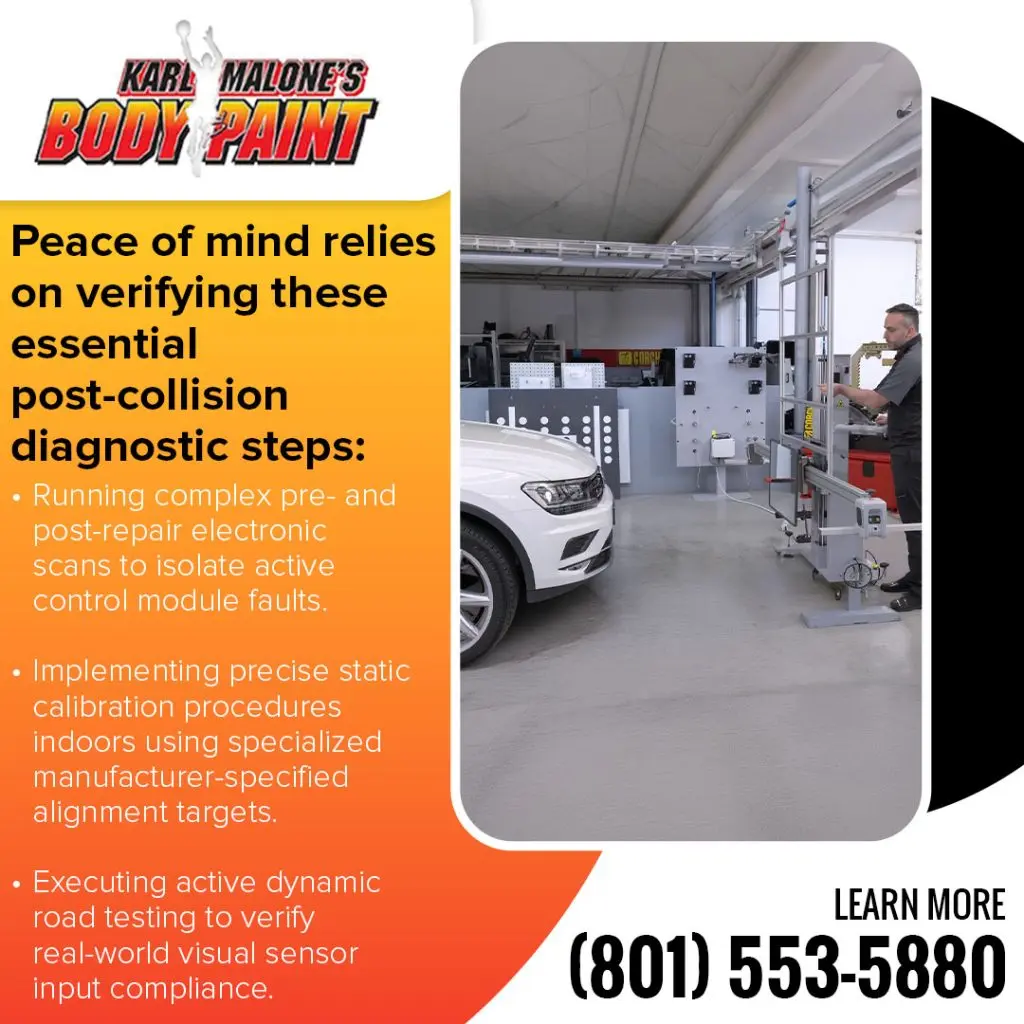
Static calibration is performed indoors, with the vehicle parked on a level surface and specialized targets placed in front of or around it. Technicians use manufacturer-specified equipment to align the system to those targets. This is required for most forward-facing camera systems, including those used in lane departure and automatic emergency braking features.
Dynamic Calibration
Dynamic calibration is completed by driving the vehicle at a specified speed for a set distance under specific road conditions. The system recalibrates itself using real-world visual input during that drive. This method is used for some radar and camera systems and is often performed after static calibration is complete.
Some vehicles require both. The only way to know which applies to your vehicle is to follow the OEM repair procedures. At Karl Malone’s Body & Paint, our technicians follow manufacturer-specified procedures for every make and model we service.
Federal Standards Are Raising the Bar on ADAS Compliance
A new federal safety standard, FMVSS No. 127, will require automatic emergency braking (AEB), including pedestrian AEB systems, as standard equipment on nearly all new passenger cars and light trucks manufactured on or after September 1, 2029. Under that standard, AEB systems must stop or avoid rear-end crashes at up to 62 miles per hour and detect pedestrians in both daylight and darkness.
As these systems become standard equipment on nearly all new vehicles, the number of cars requiring proper ADAS calibration after collision repairs is expected to increase. A bipartisan bill in the U.S. House of Representatives, H.R. 6688, known as the ADAS Functionality and Integrity Act, would require the National Highway Traffic Safety Administration (NHTSA) to develop guidelines addressing ADAS calibration procedures, tolerances, testing protocols, and performance validation following repairs, modifications, or component replacement.
The takeaway for drivers in Riverton and surrounding communities is clear: calibration standards are tightening across the industry. Choosing a trusted auto body shop that already follows rigorous calibration protocols puts you ahead of those requirements today.
Questions to Ask Your Auto Body Shop Before You Leave
When picking up your vehicle after any repair, these are the right questions to ask:
- Did you scan the vehicle for ADAS faults before and after the repair?
- Was the calibration performed using OEM-specified tools and procedures?
- Do you have a calibration report I can keep for my records?
- Was both static and dynamic calibration completed, if applicable?
- Has the vehicle been road-tested to confirm all safety features are active?
An auto body repair shop that cannot answer these questions clearly has likely not performed the calibration correctly. At Karl Malone’s Body & Paint, we document every step and walk you through the results before you drive away.
That commitment to communication is something our customers notice. Annette Flores, who brought her vehicle to us after a collision, shared: “Great customer service with excellent work. I would recommend family and friends here. Austin was wonderful to work with. Great communication. Thank you.” That kind of trust starts with transparency, including being upfront about what was done and why.
Common Questions About ADAS Calibration
Does a minor fender bender really require sensor recalibration?
Yes, even minor repairs can require recalibration if they affect any panel that houses or is adjacent to a sensor. A small fender repair may not look like it touched a sensor, but the mounting surface can shift during disassembly and reassembly. OEM repair procedures are the only reliable guide for when calibration is required.
Is ADAS Calibration Required After Windshield Replacement?
In many vehicles, yes. Forward-facing cameras used for features such as lane departure warnings, traffic sign recognition, and automatic emergency braking are often mounted behind the windshield. When the windshield is replaced, manufacturers frequently require recalibration to help ensure these systems continue operating according to OEM specifications.
Can I tell if my ADAS sensors are miscalibrated just by driving?
In many cases, no. A miscalibrated sensor may not trigger a warning light. The system may still appear to function, but respond incorrectly in real emergencies. The only reliable way to confirm calibration is a professional scan using manufacturer-specified diagnostic tools.
Does my insurance cover ADAS calibration after a repair?
Many insurance policies do cover calibration as part of auto body repair when it is properly documented. Our team at Karl Malone’s Body & Paint works directly with insurance providers and handles the documentation needed to support your claim. We take that off your plate so the process moves smoothly.
How long does ADAS calibration take?
Static calibration typically takes one to two hours. Dynamic calibration adds a road drive of roughly 20 to 30 minutes. The time varies by vehicle and the number of systems that need to be verified. We include calibration in our overall repair timeline so you are not waiting longer than necessary.
Why Karl Malone’s Body & Paint Gets ADAS Calibration Right
Karl Malone’s Body & Paint holds manufacturer certifications from Ford (FCCN), General Motors (CRN), and Toyota (TCCC). These certifications require our technicians to follow OEM repair procedures, which include the correct calibration steps for each certified make.
We use PPG Envirobase paint technology for color-accurate refinishing, and our ADAS calibration work follows the same standard of precision. Every vehicle that leaves our facility has been scanned before the repair begins and verified after it is complete.
Our location at 11535 South Lone Peak Parkway, Draper, UT 84020, serves drivers from Riverton, South Jordan, Bluffdale, and the wider Salt Lake Valley. If you have recently had auto body repair in Riverton, UT, and are not certain whether your vehicle’s safety systems were recalibrated, an ADAS inspection can help confirm that cameras, radar sensors, and driver-assistance features are functioning as intended. We can scan your vehicle and provide a clear assessment of its calibration status.
ADAS Calibration Key Takeaways
- ADAS cameras and sensors can shift during collision repairs, affecting how safety systems operate.
- Windshield replacement, bumper repairs, suspension work, and structural repairs may require recalibration.
- Vehicle manufacturers provide specific calibration requirements that should be followed after repairs.
- Improperly calibrated systems may affect automatic emergency braking, lane-keep assist, adaptive cruise control, and blind-spot monitoring features.
- Calibration documentation helps confirm that safety systems were tested and restored according to OEM procedures.
- Choosing a certified auto body shop helps ensure driver-assistance systems perform as intended.
Schedule Your Post-Repair ADAS Calibration Today
If your vehicle has recently undergone windshield replacement, bumper repair, suspension work, or collision repair, ADAS calibration may be necessary to restore sensor accuracy and safety-system performance. Verifying vehicle safety systems after repairs is an important part of the repair process, particularly when OEM procedures require calibration. At Karl Malone’s Body & Paint, we treat calibration as a non-negotiable part of every repair process.
If you are looking for a trusted auto body shop in Riverton, UT, where sensor calibration is handled correctly, call us or stop by – we are just nearby. Our team is ready to walk you through the process, document everything for your insurance, and confirm that every safety feature on your vehicle is working exactly as it should before you drive away.
To schedule auto body repair near Riverton, UT, or to ask about ADAS calibration for your vehicle, contact Karl Malone’s Body & Paint today at (801) 553-5880 or RBeck@GoMalone.com.