
What’s the one decision after an accident that could affect your family’s safety for years?The answer lies in the parts used for your collision repair. For vehicle owners in Draper, UT, facing auto collision repairs and insurance claims, the choice between OEM (Original Equipment Manufacturer) and aftermarket parts is critical. It directly impacts your car’s safety, value, and long-term performance.
At Karl Malone’s Body & Paint, we understand the complexity of this decision. That’s why we prioritize OEM parts. Our commitment is to restore your vehicle to its factory specifications, ensuring the repair doesn’t compromise the original engineering standards designed to protect you and your passengers. Your investment, and more importantly, your family’s safety, shouldn’t be left to chance.
What Are OEM Parts in Auto Collision Repair?
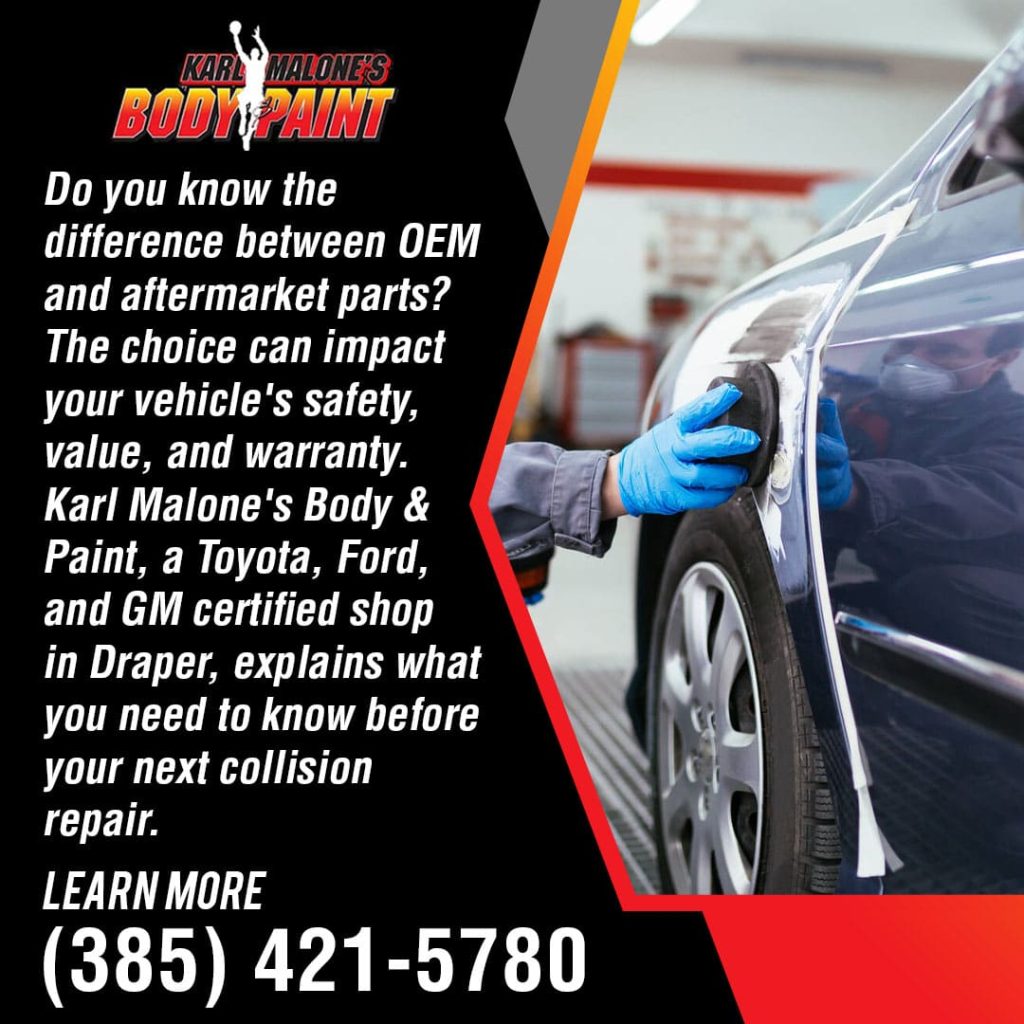
OEM parts are manufactured by your vehicle’s original maker using identical materials, specifications, and quality standards. These parts match exactly what came with your car from the factory. Toyota OEM parts for a Camry are made by Toyota using the same steel grades, paint formulations, and engineering tolerances as the original components.
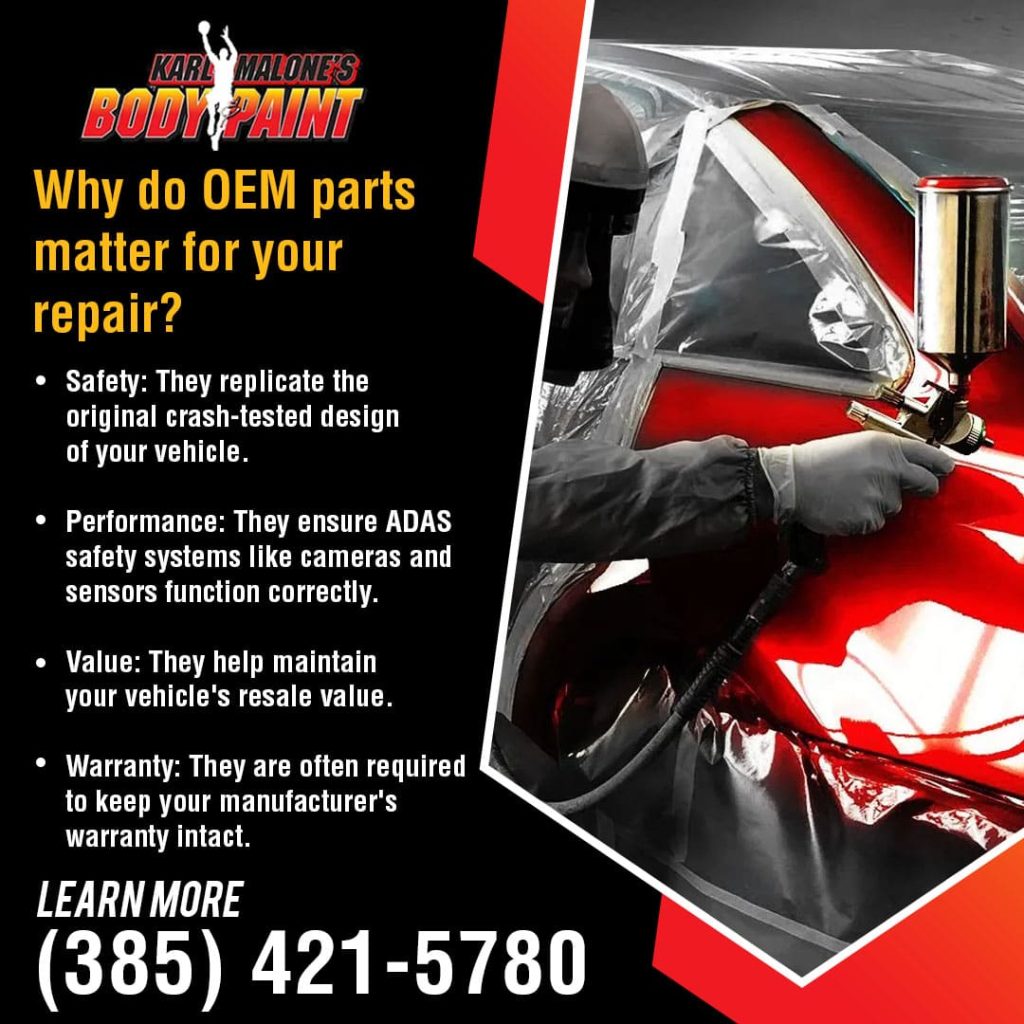
OEM parts maintain your vehicle’s structural integrity because they replicate the original crash-tested design. Structural parts must exactly replicate original components to preserve crashworthiness. Vehicle manufacturers spend millions testing how parts perform in collisions.
Your auto collision repair receives parts with manufacturer warranties. These warranties often extend 12 months and cover defects in materials or workmanship.
Understanding Aftermarket Parts for Collision Repair
Aftermarket parts are manufactured by third-party companies, not your vehicle’s original maker. These parts are designed to fit multiple vehicle models. A single aftermarket fender might be engineered to fit five different car models from various manufacturers.
Quality varies substantially among aftermarket manufacturers. Some produce parts that meet or exceed OEM standards. Others manufacture parts with different steel grades, thinner materials, or modified designs that may not provide equivalent protection.
Many aftermarket parts lack crash testing verification. The National Highway Traffic Safety Administration requires all vehicles to meet Federal Motor Vehicle Safety Standards, but aftermarket parts don’t undergo the same rigorous testing as OEM components.
CAPA (Certified Automotive Parts Association) certification helps identify quality aftermarket parts. CAPA-certified parts undergo testing to make certain that they meet specific standards for fit, finish, structural integrity, and corrosion resistance. These parts provide a middle ground between standard aftermarket components and OEM parts.
Key Differences Between OEM and Aftermarket Parts
Safety and Structural Integrity
OEM parts preserve your vehicle’s crash protection because they match original engineering specifications. Your car’s crumple zones, reinforcement structures, and safety cage work together as a system. Replacing one component with a part that has a different thickness or steel grade can affect how your entire vehicle performs in a collision.
Aftermarket parts may not maintain equivalent crash protection. Studies found that vehicles repaired with certain aftermarket structural components showed different performance in crash tests compared to those repaired with OEM parts.
Advanced Driver Assistance Systems (ADAS) depend on precise part placement. OEM parts maintain the exact positioning required for radar sensors, cameras, and other safety technology to function properly.
Fit and Finish Quality
OEM parts guarantee proper fitment because they’re made to original specifications. Panel gaps, alignment, and connection points match factory tolerances. This prevents issues like water leaks, wind noise, or premature paint failure.
Aftermarket parts may require modification for proper installation. Some aftermarket panels need trimming, drilling, or adjustment to fit correctly. These modifications can create stress points that lead to premature failure or corrosion.
Paint adhesion and color matching work better with OEM parts. Original parts receive the same surface treatments and primer applications as your vehicle’s factory finish.
Warranty and Long-term Value
OEM parts typically include manufacturer warranties that protect your investment. Most vehicle manufacturers back their parts with extensive warranty coverage that includes both the part and labor for installation.
Aftermarket parts may void existing warranties or provide limited coverage. Some aftermarket manufacturers offer warranties, but coverage terms often differ considerably from OEM protection.
Your vehicle’s resale value benefits from OEM repairs. Potential buyers and automotive appraisers can identify aftermarket repairs, which may negatively impact your car’s market value.
Insurance Considerations for Collision Repair
Your insurance company may prefer aftermarket parts to reduce claim costs. Many insurers automatically specify aftermarket components in repair estimates. However, you have the right to request OEM parts and pay any price difference.
You can negotiate with your insurance company for OEM coverage. Some policies specifically cover OEM parts, especially for newer vehicles. Review your policy language or contact your agent to understand your coverage options.
Karl Malone’s Body & Paint works directly with insurance companies to explain why OEM parts provide better value for policyholders. We document quality differences and advocate for proper repairs that maintain your vehicle’s safety and value.
When Aftermarket Parts Might Be Appropriate
Vehicles over 15 years old sometimes require aftermarket solutions when manufacturers discontinue OEM parts. Auto manufacturers typically cease production of replacement parts 10-15 years after discontinuing a model. Quality aftermarket suppliers often continue manufacturing these components, allowing classic and older vehicles to remain roadworthy.
Cosmetic repairs on non-safety components can utilize certified aftermarket parts without compromising protection. Door handles, mirror covers, trim pieces, and decorative elements don’t impact your vehicle’s structural integrity or safety systems. CAPA-certified aftermarket alternatives for these components can provide acceptable results at lower costs.
Financial considerations may favor quality aftermarket parts for specific situations. When repair costs approach your vehicle’s value, certified aftermarket components can make economic sense. We work with reputable suppliers who provide warranties and meet industry standards for non-critical applications.
The Karl Malone’s Difference in Collision Repair
At Karl Malone’s Body & Paint, we maintain manufacturer certifications that require OEM parts usage. We’re certified by Toyota, Ford, and General Motors to perform collision repair in Draper, UT, according to factory specifications. These certifications guarantee we have proper equipment, training, and parts access.
Our technicians receive ongoing training on collision repair procedures and parts requirements. We understand how different parts affect your vehicle’s performance and can explain the implications of various repair options.
We prefer manufacturer repair procedures that specify exact part requirements. These procedures are developed by engineers who designed your vehicle and tested how it performs in collisions.
Making the Right Choice for Your Auto Collision Repair
Consider your vehicle’s age, value, and your long-term ownership plans when selecting parts. Newer vehicles typically justify OEM parts because they maintain warranty coverage and resale value. Older vehicles might accept quality aftermarket alternatives for non-critical repairs.
Prioritize OEM parts for structural components, safety systems, and areas affecting ADAS functionality. These systems require precise specifications to maintain your vehicle’s protection capabilities.
Talk with our experienced technicians about your specific situation. We’ll explain which parts are critical for safety and which might accept alternatives based on your vehicle and repair needs.
Common Questions About Parts
Q: Will using aftermarket parts void my vehicle warranty?
Aftermarket parts typically don’t void your entire warranty, but they may affect coverage for related components. OEM parts maintain full warranty protection and provide compatibility with existing systems.
Q: How can I tell if a repair shop uses quality parts?
Ask about manufacturer certifications, request part specifications, and verify warranty coverage. Reputable shops will explain their parts selection and provide documentation showing part origins and quality standards.
Q: Do aftermarket parts cost much less than OEM?
Aftermarket parts typically cost 20-50% less than OEM components, but total repair costs include labor, paint, and warranty considerations. OEM parts often provide better long-term value when you consider durability and resale impact.
Q: Can I request OEM parts even if my insurance prefers the aftermarket?
Yes, you have the right to request OEM parts. You may need to pay the price difference, but many insurers will cover OEM parts when you explain the safety and value benefits.
Customer Experience at Karl Malone’s Body & Paint
Vanessa Del Valle brought her Toyota 4Runner to Karl Malone’s Body & Paint for repairing. She chose our facility specifically for our certified Toyota collision center status and commitment to quality repairs.
“I would recommend this place to anyone especially those who own a Toyota. They will make sure your vehicle is fixed well and in a way that certified and provides a warranty for the parts placed. They are the only certified Toyota collision center in Utah,” Vanessa noted.
Her vehicle was repaired using OEM parts and factory-approved procedures. “I’m glad I found this place to fix my 4Runner since we were planning on selling it before it was hit. This will help us keep some value in the fix,” she explains.
Vanessa’s experience reflects our commitment to proper auto repair that maintains vehicle value and safety standards.
Choose Quality Auto Collision Repair Shop Near You
Your vehicle represents a significant investment that deserves proper collision repair using quality parts. At Karl Malone’s Body & Paint, we’re committed to restoring your vehicle to pre-accident condition using manufacturer-specified parts and procedures.
Don’t compromise your family’s safety with substandard auto repairs. Our certified technicians use OEM parts and factory procedures to make sure that your vehicle meets original safety standards. We work with all insurance companies and provide detailed explanations of repair options and costs.
Looking for a certified auto collision repair shop near you? Contact Karl Malone’s Body & Paint today for professional collision repair in Draper, UT, and nearby areas. Call(385) 421-5780 or email RBeck@GoMalone.com to schedule your consultation. We’re here to restore your vehicle and your confidence on the road.