Not every dent qualifies for paintless dent repair, and knowing the difference saves you time, money, and disappointment.
Car dents are frustrating. They happen without warning: a shopping cart in a Draper parking lot, a hailstorm over the Wasatch Front, or a careless driver in a tight space. The question most vehicle owners ask next is simple: Can this be fixed without a full repaint? Paintless dent repair (PDR) is often the answer, but not always.
At Karl Malone’s Body & Paint, we inspect every dent before recommending a repair path. Some dents are ideal PDR candidates. Others simply are not. This article breaks down exactly when paintless dent removal works, when it doesn’t, and what it’s likely to cost you, so you can make an informed decision before your vehicle ever enters the shop.
What Is Paintless Dent Repair?
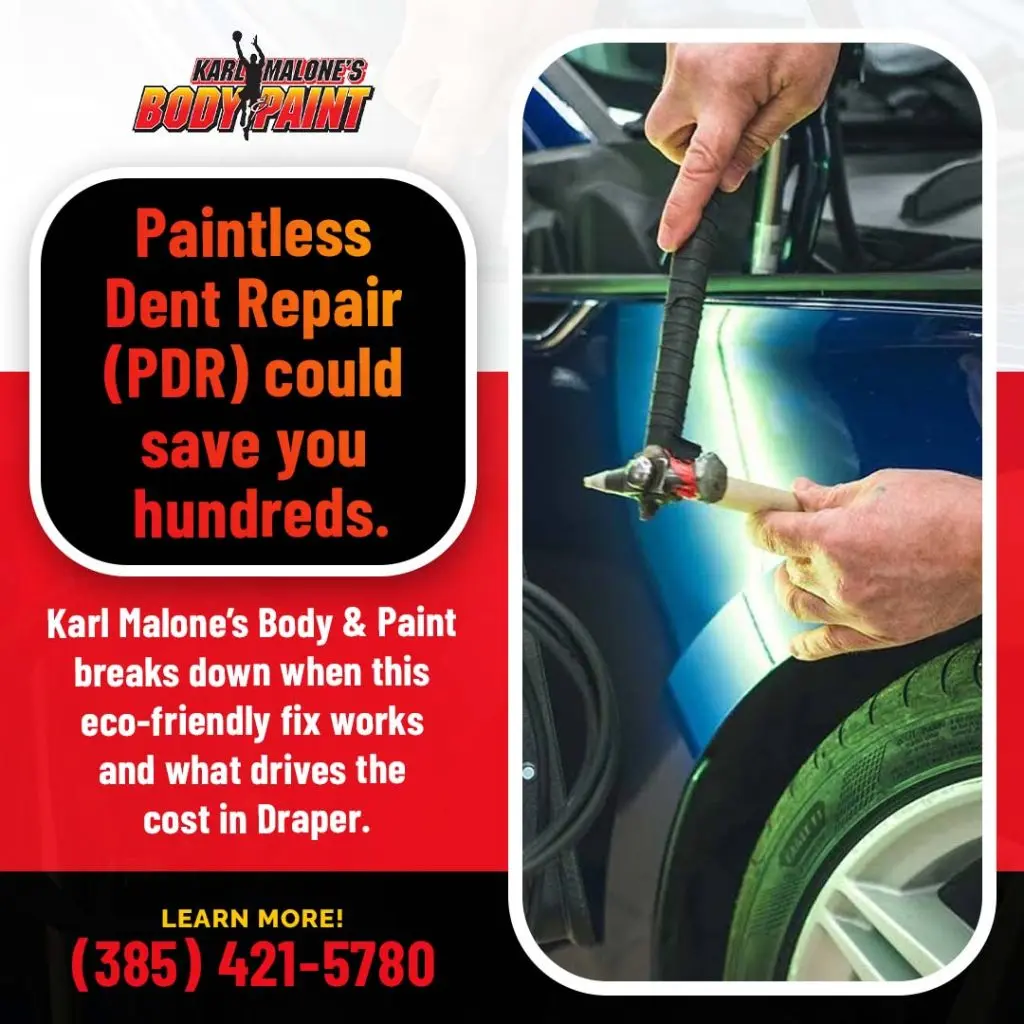
Paintless dent repair (PDR) is a technique that removes minor dents from a vehicle’s body panels without sanding, filling, or repainting.
Trained technicians use specialized metal rods and body picks to access the underside of a dented panel. They then apply careful, controlled pressure to massage the metal back to its factory shape. No filler is used. No paint is applied. The factory finish stays intact.
PDR relies on one core principle: metal memory. Steel and aluminum panels have natural elasticity. When a dent is shallow enough, and the paint above it remains uncracked, the metal can often be coaxed back to its original contour.
This method has been in use for decades and is now the preferred repair approach for many insurance companies, particularly for hail damage and door dings.
Paintless Dent Removal Cost: What to Expect
Paintless dent removal cost varies based on several factors, and the only way to get an accurate price is through an in-person inspection.
Small door dings start around $75, while larger or more complex dents can reach $150 to $350. Hail damage, which often involves dozens of dents across multiple panels, is priced differently and assessed panel by panel.
Several factors drive the final number:
- Dent size: Larger dents take longer to work. A 1-inch ding costs far less than a 4-inch impact dent.
- Dent depth: Shallow dents respond quickly. Deeper impacts require more tool manipulation and time.
- Panel location: Dents on flat surfaces like hoods and doors are easier to access. Dents near panel edges, wheel wells, or body lines require more effort and often cost more.
- Metal type: Aluminum panels are more difficult to work with than steel. Aluminum has less memory and more springback, which increases both time and cost.
- Number of dents: Multiple dents on a single panel increase labor. Some shops offer discounts for volume repairs. Ask during your estimate.
- Access requirements: If a technician must remove interior door panels, trim pieces, or taillights to reach the dent from behind, that removal and reinstallation adds labor cost.
For context, a single small door ding on an easy-to-access steel panel might cost $75 to $150. A large, deep dent near a body line on an aluminum-paneled vehicle could approach $350 or more. Hail damage covering an entire hood or roof is estimated by panel severity, not per dent.
The only way to get an accurate paintless dent removal cost is through an in-person inspection. Photos help narrow the range, but a technician needs to see the damage directly, checking paint condition, dent depth, and access points, before giving a final number.
When Paintless Dent Repair Works
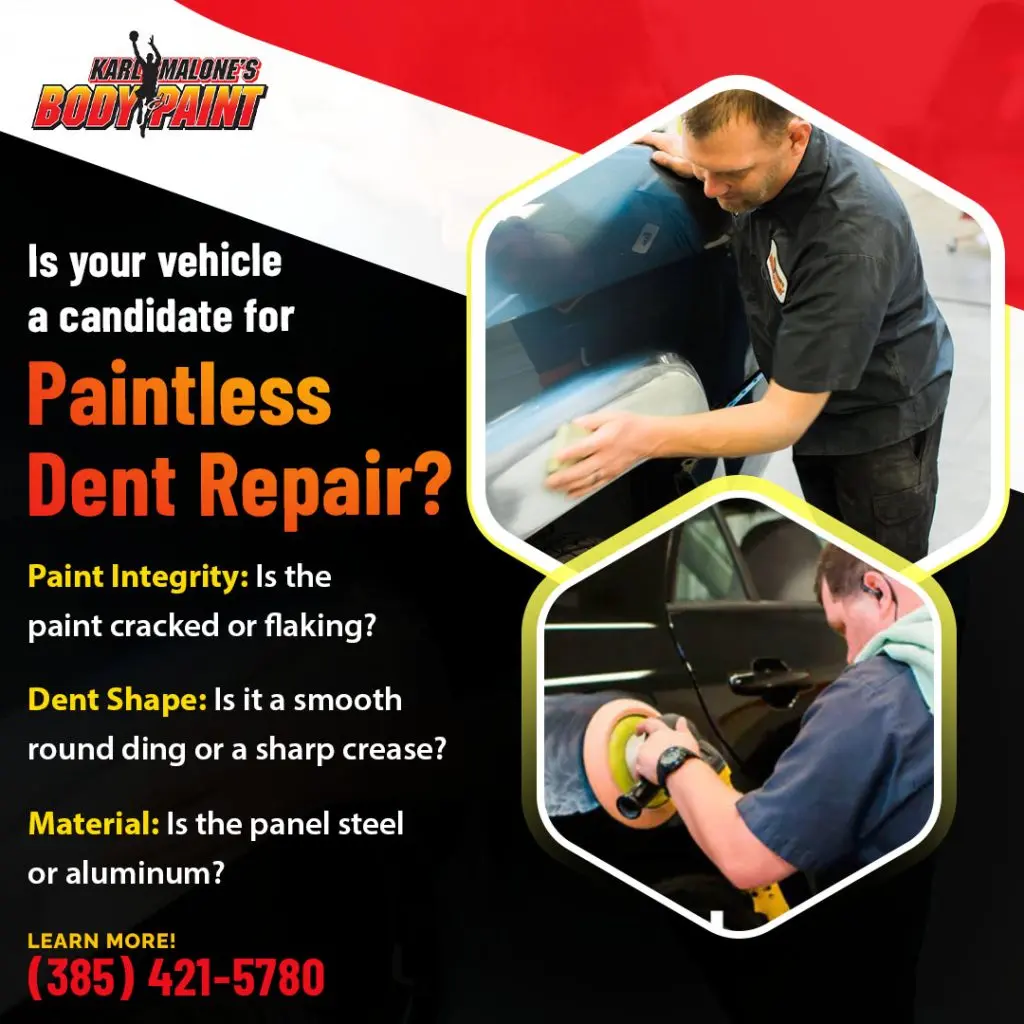
PDR works best on shallow, rounded dents where the surrounding paint remains fully intact.
Here are the most common scenarios where paintless dent removal is the right call:
Door Dings
A neighboring car door swings open and makes contact. The dent is shallow, the paint is fine, and the location, the middle of a door panel, gives a technician full access from behind. This is one of the most straightforward cases for paintless dent repair. Most door dings are resolved in under an hour.
Hail Damage
Utah’s storm season creates multiple small, rounded dents across hoods, roofs, and trunk lids. Because hail impacts are typically shallow and rarely crack paint, hail damage is one of the best applications for paintless dent removal in Draper, UT. Insurance companies recognize this and frequently prefer PDR for hail claims.
Shopping Cart and Minor Impact Dents
Parking lot dings from shopping carts or minor low-speed impacts, on flat or gently curved panels without paint cracking, typically qualify. The key factors are intact paint and reasonable access behind the panel.
Dents on Hoods, Doors, and Trunk Lids
These panels offer the most straightforward access. Technicians can position their tools cleanly without removing major components. Repairs on these surfaces tend to be faster and less costly.
When Paintless Dent Repair Does Not Work
PDR cannot fix dents with cracked or chipped paint, sharp creases, severely stretched metal, or damage in inaccessible panel locations.
This is where many vehicle owners are surprised. A dent can look minor from the outside, but still fall outside the limits of what PDR can reliably fix. Here is a breakdown of the most common disqualifying conditions:
Cracked or Chipped Paint
PDR is a metal-only repair. The technique does nothing to address paint damage. If a dent has cracked, chipped, or flaked the surface coat, the repair pathway shifts to traditional bodywork: sanding, priming, and repainting. Attempting PDR on already-damaged paint can make the condition worse.
Sharp Creases
A rounded dent has one primary stress point. A sharp crease has multiple. The metal in a creased dent has been forced along a line, creating tension at every point along that fold. Even when PDR improves the appearance, the metal may still ripple or distort under certain lighting. Sharp creases typically require traditional repair or panel replacement.
Severely Stretched Metal
When a high-force impact pushes metal past its elastic limit, the panel gains surface area that it cannot recover. PDR relies on elasticity. Stretched metal has lost that property and cannot be reliably worked back to factory contour.
Dents on Panel Edges or Body Lines
Panel edges are reinforced and tight. There is limited space to position a tool behind them. Dents along sharp body lines face a similar challenge: the line itself is a structural feature that doesn’t return to its original geometry under PDR pressure alone.
Aluminum Panels in Difficult Locations
Aluminum has less metal memory than steel. It springs back less predictably and can crack under PDR tool pressure if the force is excessive. Aluminum panels in accessible locations can sometimes be repaired with PDR, but panels in tight or braced areas often cannot.
Previously Repaired Panels
If a panel has been repaired before, especially with body filler, the surface above the metal is no longer factory paint. Non-factory finishes are less flexible and more prone to cracking under PDR tools. Previous filler also means a technician is not manipulating pure metal, which changes how the panel responds.
Structural Damage
PDR is a cosmetic repair. It restores the panel shape. It does not address frame damage, misaligned structural components, or safety-critical repairs. Any collision that affects structural integrity requires traditional collision repair, not PDR.
The Environmental Advantage of Skipping the Paint
One often-overlooked benefit of paintless dent repair is what it avoids: automotive refinishing chemicals.
The U.S. Environmental Protection Agency has established national VOC (volatile organic compound) emission standards specifically for automobile refinish coatings, recognizing that these coatings release compounds that contribute to ground-level ozone formation. You can review those standards here: EPA Automobile Refinish Coatings VOC Standards.
When paintless dent removal is viable, no paint, primer, clear coat, or solvent is used. That means zero VOC emissions from the repair itself, a meaningful difference for air quality in the Salt Lake Valley, where ozone levels are already a seasonal concern.
At Karl Malone’s Body & Paint, we use PPG Envirobase waterborne paint technology whenever repainting is required. But when PDR can do the job, we recommend it, because keeping your factory finish intact is better for your vehicle and better for the air around us.
Key Takeaways
- Paintless dent removal cost ranges from $75 to $350 per dent, depending on size, depth, location, panel material, and access requirements.
- PDR works best on shallow, rounded dents with intact factory paint, including door dings, hail damage, and minor parking lot impacts.
- PDR does not work on cracked paint, sharp creases, stretched metal, panel edge damage, structurally compromised panels, or previously filled panels.
- Skipping the repaint means skipping VOC emissions, an environmental benefit the EPA specifically recognizes in its automobile refinishing standards.
- The only reliable way to determine if your dent qualifies is an in-person inspection by a trained technician.
- At Karl Malone’s Body & Paint, we assess every dent honestly and recommend PDR only when it will deliver a result that meets factory standards.
Contact Karl Malone’s Body & Paint
Wondering if PDR is the right fix? Start with a free inspection. When you’re looking for paintless dent repair near you, our team at Karl Malone’s Body & Paint will evaluate the dent, tell you whether PDR makes sense, and give you a clear, honest estimate. Call us at (801) 553-5880 or email RBeck@GoMalone.com.