
A successful collision repair is about more than fixing dents and damaged panels. The repaired area should look as though the accident never happened. At Karl Malone’s Body & Paint, professional paint matching is an essential part of the repair process, helping restore a vehicle’s appearance after a collision.
Accurate paint matching is more complex than simply using a factory paint code. Vehicle paint changes over time due to sunlight, weather, road conditions, and normal wear. Professional collision repair centers use specialized color-matching technology, test applications, and blending techniques to ensure repaired panels match the rest of the vehicle as closely as possible.
Understanding how paint matching works can help drivers make informed decisions when choosing a collision repair center and avoid repairs that leave visible color differences after the work is complete.
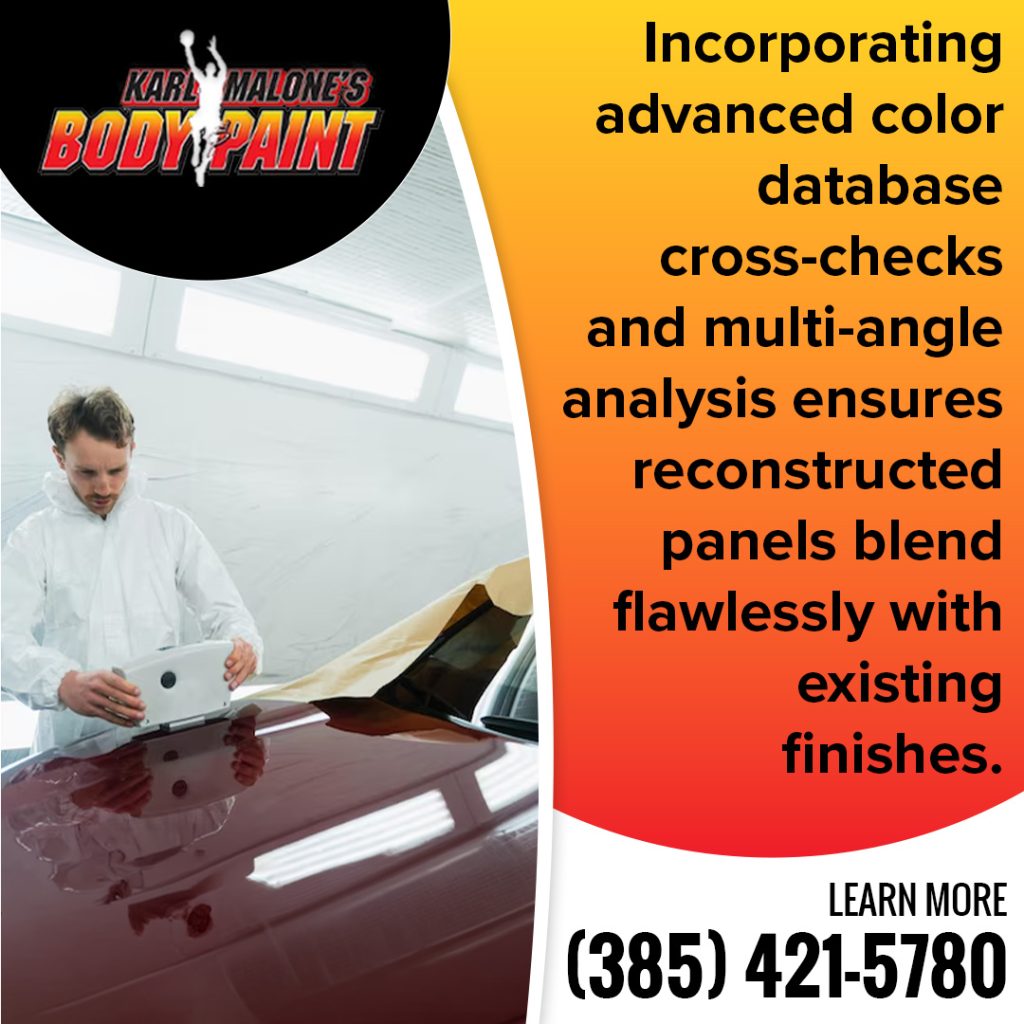
Paint Matching at a Glance
Paint matching is the process of restoring a repaired vehicle panel so it matches the surrounding paint as closely as possible. Professional collision centers use color-matching technology, test sprayouts, and blending techniques to account for paint fading, weathering, and other changes that occur over time.
Why Paint Matching Is More Difficult Than It Looks
Most drivers assume that a vehicle’s paint code is all a shop needs to reproduce the original color. That assumption leads to disappointing results. A paint code identifies the original factory formula, but it does not account for how that color has changed on your specific vehicle over time.
| Factor Affecting Paint Match | How It Affects Paint Color |
| UV Exposure | Sunlight gradually fades pigments, often causing the hood, roof, and other exposed surfaces to age differently. |
| Environmental Exposure | Pollution, road salt, chemicals, moisture, and temperature changes can alter how paint reflects light over time. |
| Batch Variations | Paint from different production batches can vary slightly, even when it carries the same factory color code. |
| Vehicle Age | Original paint may no longer match factory specifications. |
| Application Conditions | Spray technique, equipment settings, humidity, and drying conditions can affect the final appearance of a new paint application. |
Automotive color specialists note that vehicle paint can shift significantly over time due to UV exposure, oxidation, and environmental wear. Studies and industry guidance show that even small color differences can become noticeable as a vehicle ages. As a result, using only the original OEM paint code on older vehicles often does not produce a seamless match without adjustment.
How Professional Paint Matching Actually Works
Step 1: Spectrophotometer Reading
Professional collision repair starts with a device called a spectrophotometer. This tool measures the exact color and texture of the vehicle’s existing paint across multiple viewing angles. It accounts for metallic flake orientation, pearlescent layers, and the specific way light reflects off the aged surface.
PPG, the paint technology provider used at Karl Malone’s Body & Paint, produces spectrophotometer systems that interface directly with their color formula database. Their database contains formulas for more than 5 million colors. The device reads the vehicle’s actual surface and finds the closest match in real time, not just the factory code on file.
Step 2: Formula Retrieval and Adjustment
Once the reading is complete, the formula is pulled from the database and reviewed. Technicians may make small adjustments based on the reading results, the age of the vehicle, and local environmental factors. The goal is not simply to reproduce the original factory color. The goal is to match how the vehicle looks today.
Step 3: Test Sprayout
Before any paint touches the damaged panel, a test sprayout is applied. This is a sample application on a card or test surface that lets the technician compare the mixed formula against the vehicle under natural and artificial light. Some shops skip this step to save time. Reputable shops do not.
Step 4: Blending
Even with an accurate formula, blending is often required. Rather than painting only the damaged panel with a hard edge, technicians feather the new paint into adjacent panels. This creates a gradual transition that the eye cannot detect. Blending is one of the most skill-dependent parts of the process and one of the clearest ways to tell apart a rushed repair from a professional one.
Why Many Professional Collision Centers Use Waterborne Paint Systems
Not all collision repair paint systems are equal in their environmental impact. Traditional solvent-based automotive paints release volatile organic compounds (VOCs) into the atmosphere during application and curing. The U.S. Environmental Protection Agency has established national VOC emission standards specifically for automobile refinish coatings, estimating that the rule reduces VOC emissions by 31,900 tons per year compared to 1995 baseline levels.
Karl Malone’s Body & Paint uses PPG Envirobase, a waterborne paint system. Waterborne formulas release far fewer VOCs than solvent-based systems. The EPA identifies waterborne coatings as a recommended substitution method for reducing VOC content in the refinishing process. This matters for air quality in Utah, where ground-level ozone and inversion events are a recurring concern along the Wasatch Front.
Choosing a collision center near Riverton, UT, that uses waterborne paint technology can help reduce environmental impact while still delivering a high-quality finish.
What Happens When Paint Matching Is Done Poorly
Poor paint matching can affect both the appearance and long-term value of a vehicle. Common consequences include:
- Reduced resale value – Visible color differences can signal previous damage and lower buyer confidence.
- Noticeable repair lines – Mismatched paint can make repaired panels stand out from the rest of the vehicle.
- Future paint failure – Improper refinishing techniques may lead to peeling, fading, or chipping over time.
- Insurance claim complications – Poor-quality repairs can raise questions during future damage assessments or claims.
Professional paint matching helps restore a vehicle’s appearance while supporting long-term durability and value retention.
What to Look for in a Collision Center Near Riverton, UT
Not all auto body shops approach refinishing the same way, and paint quality often reveals how detailed their repair process really is. When comparing options for auto collision repair near Riverton, UT, it helps to ask a few practical questions about how color matching and refinishing are handled.
Start by asking whether the shop uses a spectrophotometer for color matching or depends only on factory paint codes. It’s also worth confirming what paint system is used and whether it meets OEM certification standards.
You can also ask if technicians carry out test sprayouts before applying paint to the vehicle, as this step helps verify color accuracy. Blending practices are another key point. Some shops blend panels as part of standard procedure, while others only do it when requested.
Finally, check whether the shop uses modern waterborne paint systems, which are widely used in professional refinishing for consistency and environmental compliance.
Shops that can clearly explain these steps are generally more focused on achieving a seamless, factory-like finish rather than a basic repair.
Karl Malone’s Body & Paint: Paint Matching at the Professional Level
At Karl Malone’s Body & Paint, our car accident repair process includes PPG Envirobase waterborne paint technology and color-matching tools calibrated for each vehicle. Our manufacturer certifications from Ford, General Motors, and Toyota require us to follow OEM-specified refinishing procedures for certified makes. That means the correct primer systems, the correct basecoat formulas, and the correct clearcoat products for each repair.
For many drivers, the quality of a repair becomes obvious the moment they see the finished vehicle. It is the most visible evidence of whether the work was done right. A. Ellsworth, who brought her vehicle to us after a rear-end collision in a parking lot, put it directly: “These guys made my car amazing! The paint matches perfectly.” That result starts long before the paint gun comes out.
Drivers seeking collision repair in Riverton, UT, and throughout the Salt Lake Valley can contact us using the information below. We serve Draper, South Jordan, Bluffdale, Riverton, and nearby communities from our facility at 11535 South Lone Peak Parkway, Draper, UT 84020.
Key Takeaways
- Factory paint codes alone do not guarantee a perfect color match.
- Vehicle paint changes over time due to sunlight, weather, and environmental exposure.
- Spectrophotometers measure a vehicle’s current paint condition for greater accuracy.
- Test sprayouts help verify color before paint is applied.
- Blending techniques create a seamless transition between repaired and original panels.
- Professional paint matching helps protect appearance and resale value.
Common Questions About Paint Matching After Collision Repair
Drivers often have questions about how paint matching works and what to expect during the refinishing process. Here are answers to some of the most common questions.
Why Doesn’t My New Paint Match the Rest of My Car?
Even when the correct factory paint code is used, vehicle paint changes over time because of sunlight, weather exposure, oxidation, and normal wear. Professional collision centers use spectrophotometers, formula adjustments, and blending techniques to match the vehicle’s current color rather than the original factory finish.
Does my insurance cover paint matching as part of auto collision repair?
Yes, paint matching and blending are standard parts of a covered collision repair. These are commonly included as part of covered collision repairs when necessary to restore the vehicle’s appearance. Our team handles the documentation and works directly with your insurer throughout the process.
Can you match paint on older vehicles with significant fading?
Yes, this is exactly where spectrophotometer-based matching is most valuable. Rather than using the factory code from decades ago, the device reads the actual color on the vehicle today and finds the closest formulation to that specific, aged surface.
What is blending, and do I need it?
Blending is the process of feathering new paint into adjacent panels to eliminate a visible edge. Most repairs benefit from some degree of blending, especially on metallic and pearl colors, where angle-dependent light reflection makes hard edges obvious. Whether blending is required depends on the panel location and color type.
How long does a paint-matched repair last?
A properly applied repair using OEM-approved materials should last the life of the vehicle. Paint failure after a repair is almost always the result of improper surface preparation, incorrect primer application, or a mismatch between the paint system and the panel substrate. We follow manufacturer-specified procedures to prevent all of these.
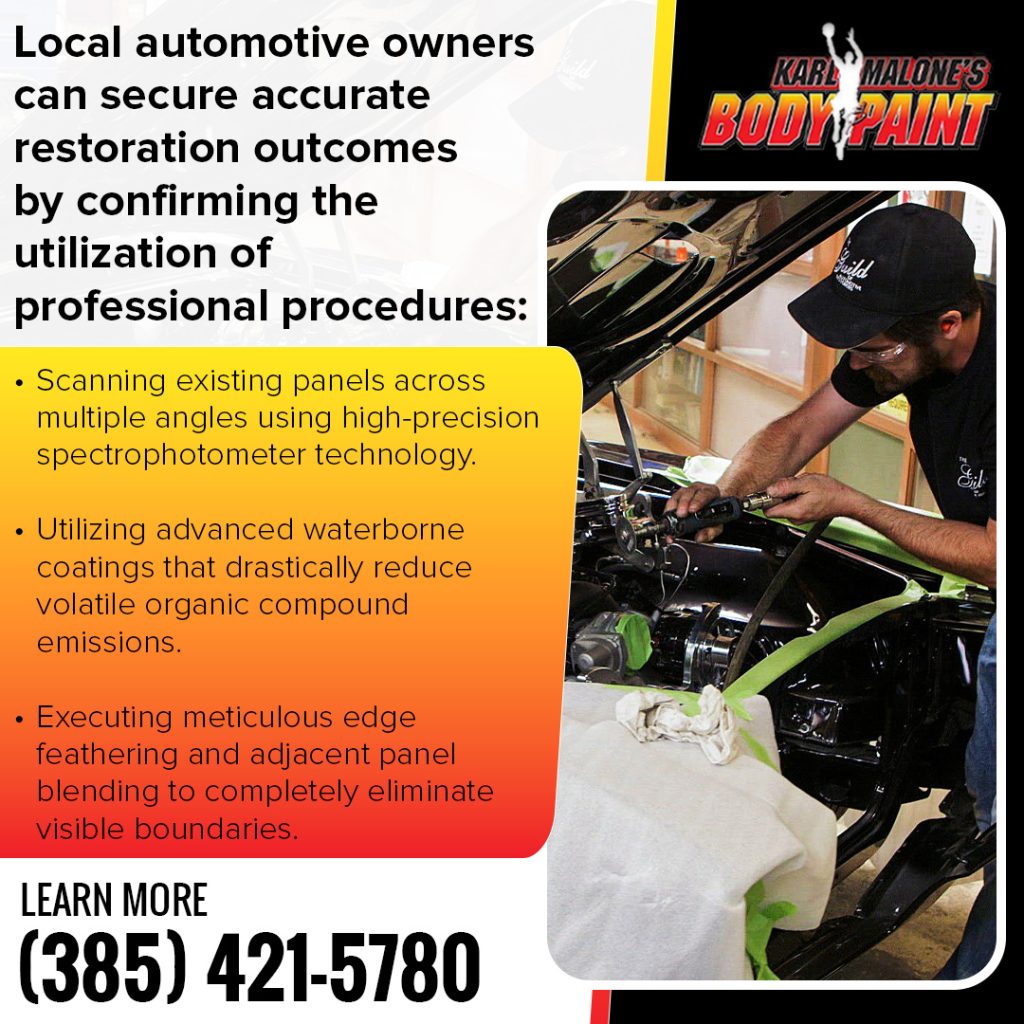
Your Car Deserves a Finish That Matches
A car accident repair is only complete when the repaired area is indistinguishable from the rest of the vehicle. Paint matching is not a cosmetic bonus. It is the final confirmation that the work was done to a professional standard.
You deserve a collision center that treats color accuracy with the same discipline as structural repair. At Karl Malone’s Body & Paint, every auto collision repair goes through a documented paint-matching process using PPG Envirobase waterborne technology and spectrophotometer-verified formulas. The result is a finish that holds up over time and stands up to scrutiny.
If your vehicle has been in an accident, choosing a facility for collision repair near Riverton, UT, that prioritizes precise paint matching can help restore both the appearance and value of your vehicle. At Karl Malone’s Body & Paint, we combine advanced color-matching technology, OEM-approved refinishing procedures, and skilled craftsmanship to deliver seamless results. Call us at (801) 553-5880, email RBeck@GoMalone.com, or visit our facility to learn how we can help return your vehicle to its pre-accident condition.